
Core Technology
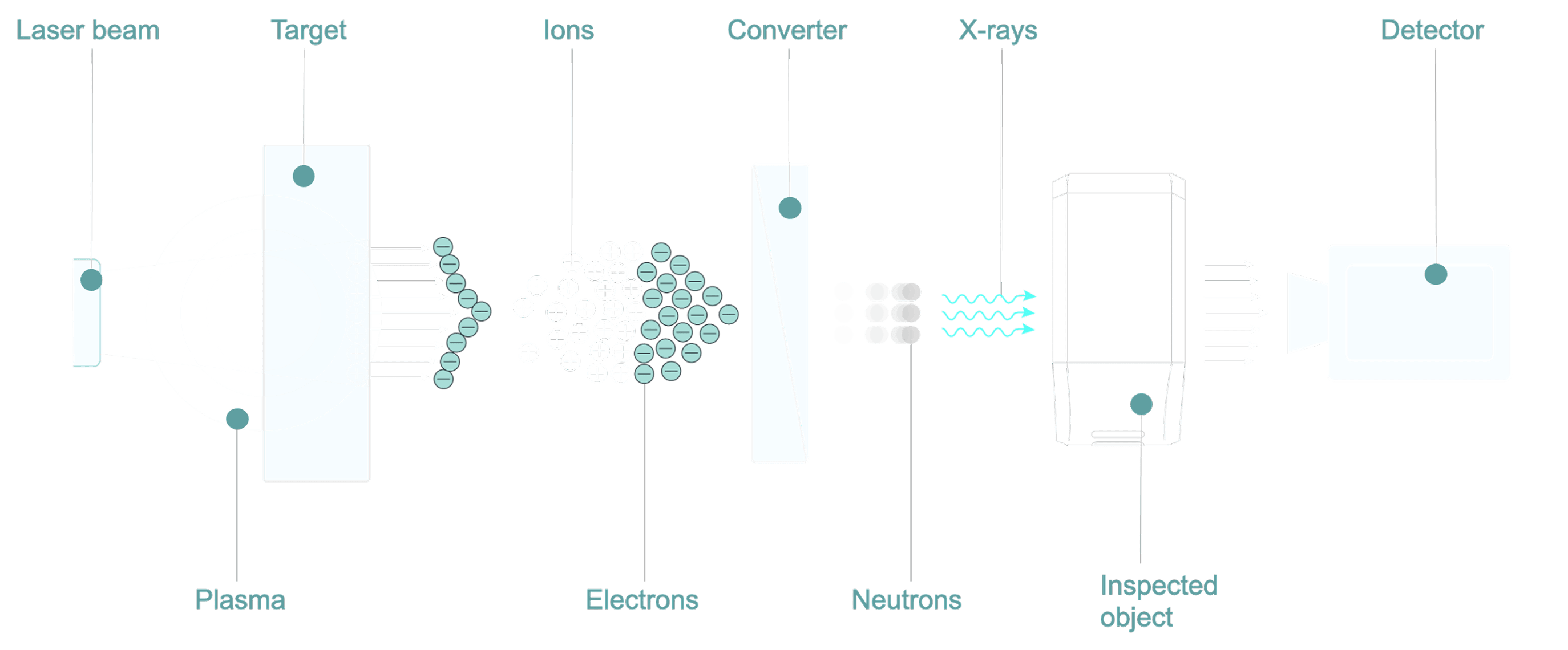
LDRS technology integrates high-energy MeV X-rays and fast neutrons in one compact, laser-driven platform.

The platform combines high-penetration structural imaging with neutron-based material evidence, supporting decisions on sealed, shielded, or hazardous objects.
Structural Imaging
High-energy X-rays enable high-penetration structural imaging, supporting detection of internal geometries, voids, or dense structures.
Material-level Evidence
Fast neutrons add sensitivity to light elements and composition-relevant material signatures, supporting material discrimination in shielded objects.
Synchronized Data Fusion
Synchronized X-ray and neutron data can be combined into fused datasets that support composition-relevant interpretation.
Decision Support
The combined dataset supports decisions on whether objects should be accepted, flagged, repackaged, isolated, or investigated further.
How it Works
MeV X-rays reveal structural integrity, density distribution, cracks, voids, and mechanical defects.
How it Works
Fast neutrons detect light elements such as hydrogen, enabling identification of organics, plastics, explosives, liquids, and moisture — even when shielded by thick metal.
Core Technology
LDRS technology integrates high-energy MeV X-rays and fast neutrons in one compact, laser-driven platform.
Core building blocks have been demonstrated at lab and subsystem level; integrated system validation is underway at our Biblis prototype system.
High Penetration Power
Penetrates more than 500 mm of high-density shielding.
High Spatial Resolution
Down to ~100 microns under defined conditions, for detecting concealed defects and objects.
Material Discrimination
Simultaneous identification of structure and substance in a single scan.
Compact Architecture
Containerized, modular design suitable for field deployment.
Automated Analysis
Algorithm-driven image fusion enables automated classification and reduces human interpretation errors.
Customers are forced to trade off insight, throughput, and deployability. Existing solutions rarely combine all three in an industrial workflow.
Deep interrogation capability, but not practical for routine industrial deployment or field use.
The unmet need is a deployable system combining penetration depth, material-level insight, and industrial integration - in a single platform.
Material sensitivity is meaningful, but industrialization into compact, certified workflows remains unsolved.
Deployable and widely adopted, but limited material discrimination behind shielding or dense structures.
All core components of the LDRS technology have been validated in relevant laser-plasma environments. Radiography has been successfully recorded using laser-driven sources, and material identification has been verified through accelerator experiments and simulations.
The technology is progressing toward TRL 9 by 2030.
A high-power laser pulse hits a target, creates plasma, accelerates particles, and generates X-ray and neutron output for inspection.